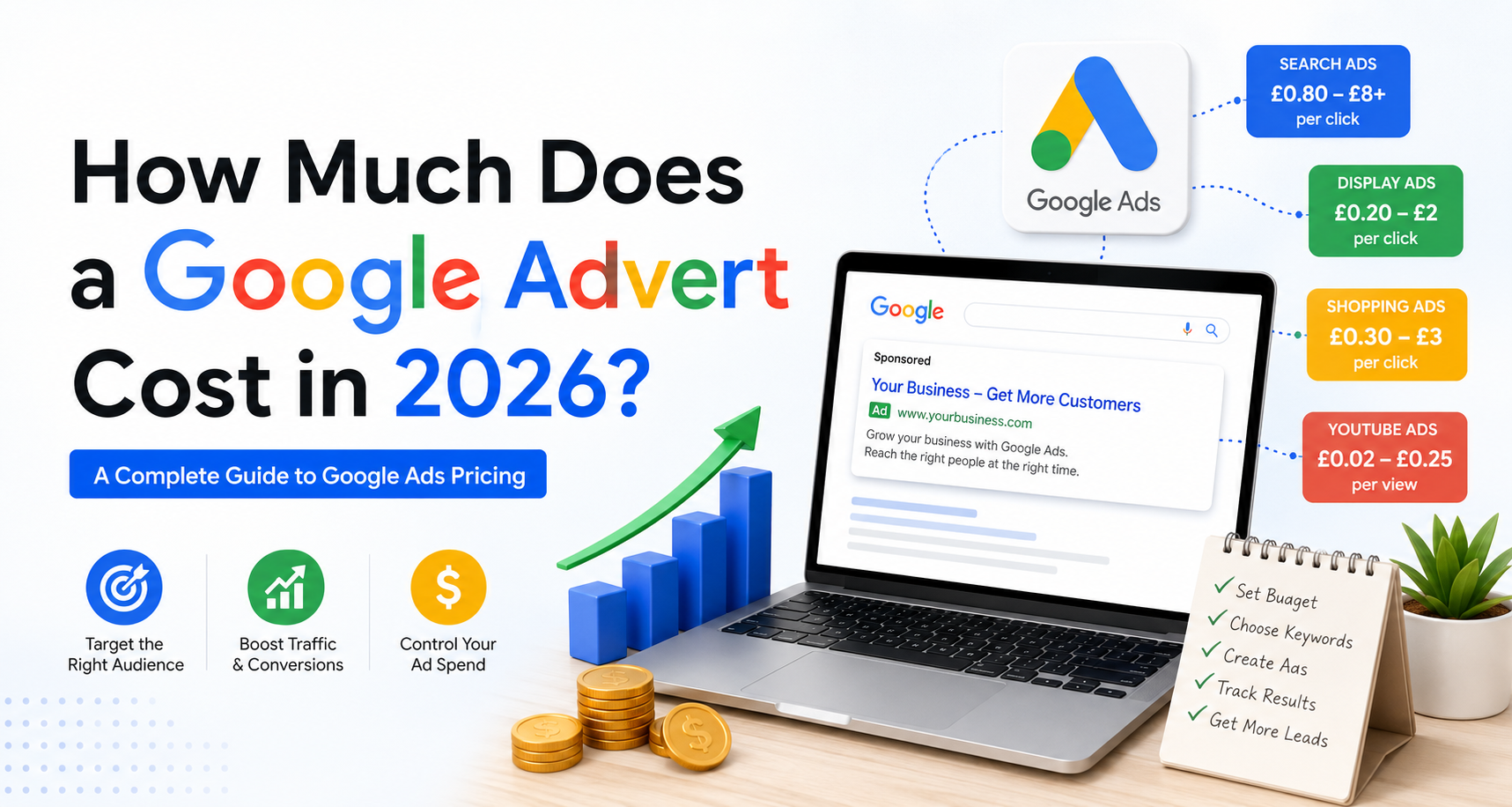
If you've ever wondered "How much does a Google Advert cost?", you're not alone. Whether you're a small business owner, startup founder, freelancer, or marketing professional, understanding Google Ads pricing is essential before investing in paid advertising.
The truth is, there isn't a fixed price for a Google Advert. Instead, the cost depends on factors like your industry, competition, keyword selection, bidding strategy, and the quality of your ads.
In this guide, we'll answer the most common questions people ask about Google advertising, explain how pricing works, and share practical tips to help you get the best return on your advertising budget.
What Is a Google Advert?
A Google Advert is a paid advertisement that appears across Google's ecosystem, including:
- Google Search results
- YouTube
- Google Shopping
- Gmail
- Google Maps
- Millions of websites within the Google Display Network
Businesses advertise with Google Ads to reach potential customers who are actively searching for products or services. Unlike traditional advertising, you generally only pay when someone interacts with your ad, making it one of the most effective forms of digital marketing.
How Much Does a Google Advert Cost?
There is no universal price for a Google Advert.
Here's a general breakdown for 2026:
| Campaign Type | Average Cost |
|---|---|
| Search Ads | £0.80 – £8+ per click |
| Display Ads | £0.20 – £2 per click |
| Shopping Ads | £0.30 – £3 per click |
| YouTube Ads | £0.02 – £0.25 per view |
| Local Campaigns | Varies by competition |
Highly competitive industries like legal services, insurance, finance, and software often pay £20–£80 or more for a single click, while local businesses may pay less than £1.
Remember:
Google doesn't charge a fixed advertising fee. Instead, you decide how much you're willing to spend.
How Does Google Decide the Cost?
Google uses an auction every time someone performs a search.
Your cost depends on several factors:
1. Keyword Competition
Popular keywords usually have higher costs.
For example:
- "Personal injury lawyer" costs significantly more than
- "Dog groomer near me"
The more businesses competing for a keyword, the higher the price.
2. Quality Score
Google rewards advertisers who create helpful, relevant ads.
Quality Score considers:
- Ad relevance
- Expected click-through rate (CTR)
- Landing page experience
Higher Quality Scores often reduce advertising costs while improving rankings.
3. Bid Strategy
You can choose different bidding methods, including:
- Manual CPC
- Maximize Clicks
- Maximize Conversions
- Target CPA
- Target ROAS
Each bidding strategy affects how much you ultimately pay.
4. Industry
Some industries naturally have expensive keywords because customer lifetime value is high.
Examples include:
- Legal
- Insurance
- Real Estate
- Finance
- Healthcare
- SaaS
Local restaurants, photographers, gyms, and salons generally experience lower costs.
Is There a Minimum Budget?
No.
One of the biggest myths about Google advertising is that you need thousands of pounds to get started.
In reality, you can begin with:
- £5 per day
- £10 per day
- £20 per day
Google allows you to control your daily budget, meaning you never have to exceed your spending limit.
What Is Cost Per Click (CPC)?
Cost Per Click (CPC) is exactly what it sounds like.
You only pay when someone clicks your advertisement.
Example:
Daily Budget: £20
Average CPC: £2
Expected Clicks:
£20 ÷ £2 = 10 visitors per day
This pricing model is why many businesses choose Google Paid Search over traditional advertising methods.
What Is a Pay Per Click Campaign?
A Pay Per Click Campaign is an advertising strategy where businesses pay only when someone clicks their advertisement.
Google Ads is the world's largest PPC platform.
Benefits include:
- Instant website traffic
- Measurable ROI
- Budget control
- Precise audience targeting
- Fast campaign optimisation
A well-managed Pay Per Click Ad campaign can generate leads within hours of launching.
How Much Should Small Businesses Spend?
There's no single answer.
Many small businesses begin with:
| Business Type | Suggested Monthly Budget |
|---|---|
| Local Business | £150–£500 |
| Small Ecommerce Store | £500–£2,000 |
| Growing Business | £2,000–£10,000+ |
Start with a manageable budget, analyse your results, then scale successful campaigns.
Are Google Ads Worth It?
Yes, if your campaigns are properly managed.
Businesses continue to advertise with Google Ads because they can:
- Reach customers with high buying intent
- Measure every click and conversion
- Scale campaigns quickly
- Pause advertising anytime
- Improve campaigns using real performance data
However, poorly targeted campaigns can waste money.
Success depends on research, optimisation, and continuous testing.
Sponsored Google Ads Explained
Many users notice advertisements labelled "Sponsored" at the top of Google search results.
These are known as Sponsored Google Ads.
They appear above organic search results because advertisers have entered Google's ad auction for those keywords.
Being labelled "Sponsored" doesn't automatically mean they're the best businesses—it simply means they've paid to appear in that position while also meeting Google's quality requirements.
Google Ads vs SEO
Many people ask whether they should invest in Google Ads or SEO.
Here's a quick comparison:
| Google Ads | SEO |
|---|---|
| Immediate visibility | Long-term organic growth |
| Pay for every click | No payment per click |
| Fast lead generation | Builds sustainable traffic |
| Easy testing | Requires ongoing optimisation |
The strongest digital marketing strategies often combine both approaches.
Online Advertising Platforms Compared
Although Google remains the largest advertising platform, businesses also use other online advertising platforms, including:
- Microsoft Ads
- Meta Ads (Facebook & Instagram)
- LinkedIn Ads
- TikTok Ads
- Pinterest Ads
- Amazon Ads
Each platform reaches different audiences and works best for different business goals.
Search Engine Marketing (SEM) Explained
Search Engine Marketing (SEM) is the broader strategy of promoting businesses through search engines.
SEM includes:
- Google Ads
- Bing Ads
- Shopping campaigns
- Search advertising
- Display advertising
SEO and PPC work together under the wider umbrella of search engine marketing.
Frequently Asked Questions
How much does one Google Advert cost?
There isn't a fixed cost. Some clicks cost less than £1, while competitive industries can pay over £50 per click.
Can I advertise with Google Ads for free?
No.
Google Ads is a paid advertising platform. However, you choose your own budget and spending limits.
Is £10 per day enough?
Yes.
Many local businesses successfully generate leads with a £10 daily budget when targeting the right audience.
How long does it take to see results?
Most campaigns begin receiving impressions and clicks within a few hours after approval.
Meaningful optimisation usually takes several weeks as data accumulates.
What is better: SEO or Google Ads?
Neither is universally better.
SEO builds long-term organic visibility, while Google Ads delivers immediate traffic. Many successful businesses invest in both.
Why are some Google Ads so expensive?
Costs increase when:
- Competition is high
- Keywords have strong commercial intent
- Multiple advertisers bid aggressively
- Customer lifetime value is high
Can I stop my ads anytime?
Yes.
Google Ads allows advertisers to pause, edit, or stop campaigns whenever they choose.
Tips to Reduce Google Advertising Costs
If you're looking to improve ROI, consider these best practices:
- Choose highly relevant keywords.
- Improve your landing page experience.
- Write compelling ad copy.
- Add negative keywords.
- Optimise your Quality Score.
- Test multiple headlines and descriptions.
- Monitor conversion tracking regularly.
- Focus on high-intent search queries instead of broad keywords.
Small improvements across these areas can significantly reduce your average cost per click.
Final Thoughts
Understanding how much a Google Advert costs is less about finding a fixed price and more about understanding how Google's auction system works.
Whether you're launching your first campaign or scaling an existing one, success comes from targeting the right audience, selecting relevant keywords, improving Quality Score, and continuously optimising performance.
If you're planning to advertise with Google Ads, start with a realistic budget, measure your results, and refine your strategy over time. Combined with a strong SEO strategy and broader search engine marketing efforts, Google Ads can become one of the most effective channels for generating qualified traffic, leads, and sales.